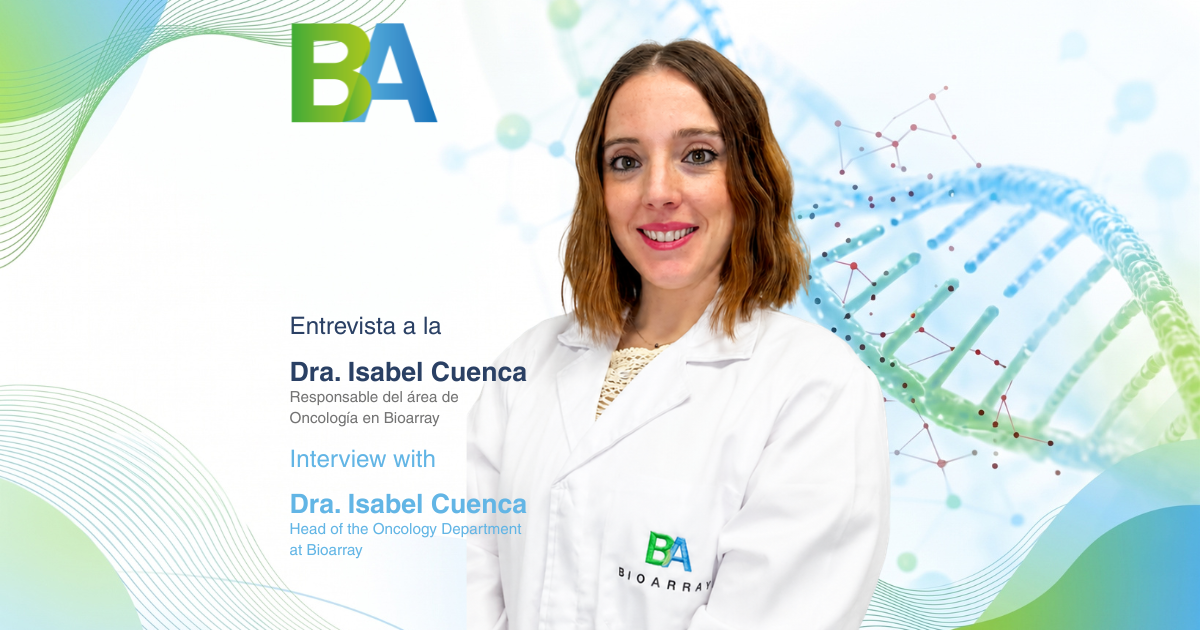
From Traditional Medicine to Personalized Oncology: An Interview with Isabel Cuenca
The way we approach and treat cancer is undergoing an unprecedented revolution. We have left behind the days of generic treatments and entered an era of clinical precision. To better understand this paradigm shift, we analyze the key points from our recent interview with Isabel Cuenca, an expert in cutting-edge laboratories and genetic innovation.
The Genetics of Cancer: Changing the Rules of the Game
As Isabel Cuenca explains, the genetics of cancer has completely transformed our approach to the disease. In recent decades, medicine has evolved from traditional oncology to personalized oncology.
What does this mean in practice? Today, patients are no longer treated solely based on the location of their tumor (for example, lung or breast), but rather on the specific type of tumor they have at the molecular level. As Cuenca aptly points out, “Two people with colon cancer don’t necessarily need to be treated in the same way.”
The Power of Massive Sequencing and Biomarkers
This medical advance has been made possible by the development of powerful new technological tools, most notably next-generation massive parallel sequencing. This technology allows specialists to fully characterize the tumor.
Each tumor has unique characteristics, known as biomarkers. Knowing a tumor’s genetic profile allows oncologists to:
- Whether it will be more or less aggressive.
- What is your forecast?
- Which specific treatments will it respond best to?
A Catalog of Solutions for Every Need
To address these daily challenges, state-of-the-art laboratories offer comprehensive solutions ranging from initial diagnosis to follow-up. The current test catalog includes:
- Studies of tissue samples in paraffin.
- Liquid biopsy, a revolutionary and less invasive technique.
- Germline studies for the detection of hereditary syndromes.
- Recent tests for the study of minimal residual disease, vital to prevent relapses.
Real Benefits for Doctors and Patients
Although the basis of this advance is purely technological and laboratory-based, Dr. Isabel Cuenca emphasizes that the ultimate goal is always people: “We work for and with the patients who are waiting for an answer and a treatment.”
For clinicians:
Technology allows them to “put a name and surname” to the tumor. By knowing it better genetically, they can design a much more effective and personalized treatment.
For patients:
In times of great physical and emotional suffering, speed is vital. The work of these highly innovative laboratories translates into shorter, more concise answers, allowing for much faster initiation of personalized treatments, thus improving life expectancy and quality of life.
Genetics is not just the future of cancer treatment, it’s the present. Thanks to professionals like Isabel Cuenca and innovative laboratories, medicine is now more precise, faster, and more humane than ever before.
👉 We’ll be at ESMO 26. Book an interview with our team at the following link: https://docs.google.com/forms/d/e/1FAIpQLSdrmNcSnmvitWzTU4CKDz6AnK6MvkJS4NQOlIhw63NhqHbtRQ/viewform