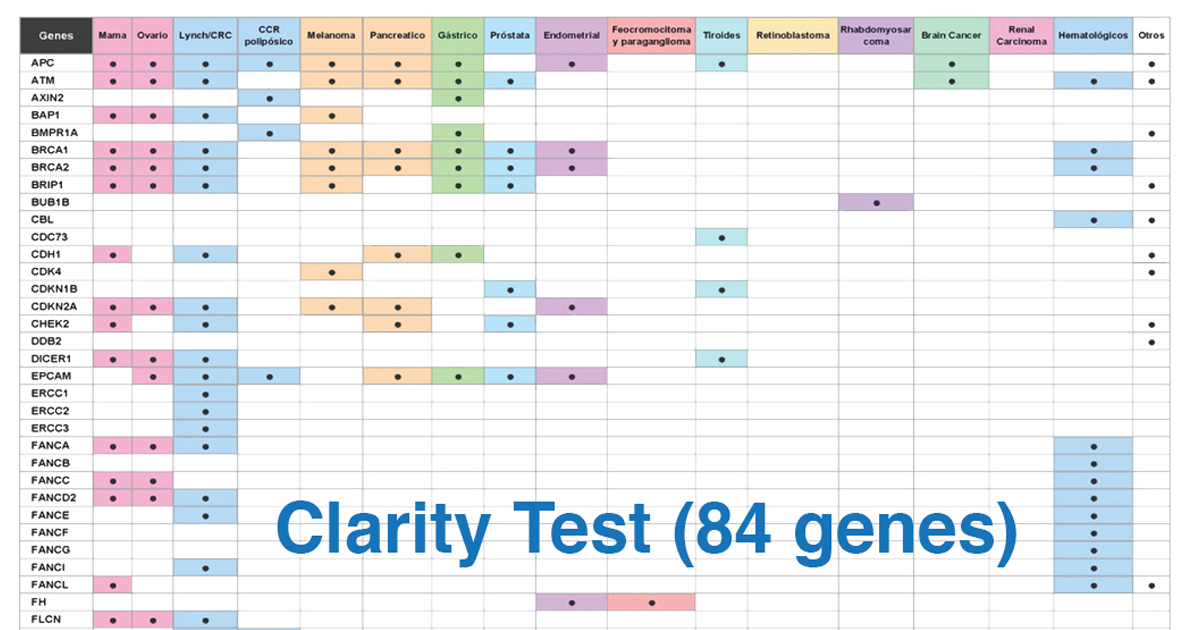
Bioarray updates Clarity Test: now with 84 genes for hereditary cancer syndromes
Bioarray has updated Clarity Test, its genetic panel for hereditary cancer syndromes, expanding the number of analyzed genes from 39 to 84. This improvement increases the diagnostic potential of the test without increasing the cost for the clinician or the patient, reinforcing the company’s commitment to a more precise, accessible genetic diagnosis aligned with the most recent scientific evidence.
The update responds to a philosophy of continuous improvement that seeks to offer increasingly comprehensive tools for the study of genetic predisposition to cancer, facilitating clinical decision-making and access to relevant molecular information for patients and professionals.
An update oriented toward expanding diagnostic potential
Hereditary cancer syndromes represent a significant portion of cases involving genetic predisposition to tumor development. The identification of pathogenic variants in associated genes allows for the establishment of surveillance, prevention, and follow-up strategies adapted to individual risk.
With this new update, Clarity Test expands its diagnostic scope while maintaining the same accessibility for the centers and professionals who use the test on a regular basis.
The objective is to provide broader coverage of genes related to hereditary predisposition to cancer, facilitating a more comprehensive genetic evaluation when there is clinical suspicion or compatible family history.
From 39 to 84 genes: what changes in the new version
The main new feature of Clarity Test is the expansion of the panel from the original 39 genes to a total of 84 analyzed genes.
This improvement allows for an increased capacity to detect genetic alterations associated with different hereditary cancer syndromes, offering a more robust tool for the molecular study of patients with genetic risk.
Main features of the new Clarity Test:
- 84 genes analyzed
- 100X average coverage
- 98.90% sensitivity
- 98.40% specificity
- No cost increase for clinicians or patients
- Possibility of analysis through specific subpanels
The incorporation of new genes responds to the constant evolution of scientific knowledge in oncological genetics and the need to adapt diagnostic tools to advances in precision medicine.
Specific subpanels for different hereditary syndromes
In addition to the full panel, Clarity Test allows for the selection of specific subpanels for certain clinical indications.
This approach facilitates a more targeted evaluation when there is suspicion of certain hereditary syndromes or specific family history.
Breast and ovarian cancer
The breast and ovarian subpanels are oriented toward the study of genes related to hereditary predisposition to these tumors.
Their use can be especially helpful in patients with relevant family history, diagnoses at early ages, or clinical criteria suggesting a hereditary genetic basis.
Prostate cancer and Lynch syndrome
The panel also includes specific subpanels for hereditary prostate cancer and for Lynch syndrome/hereditary colorectal cancer.
These studies allow for the evaluation of genes associated with recognized predisposition syndromes and provide useful information for clinical assessment, follow-up, and, where appropriate, the study of family members.
Technical specifications and sample types
The update maintains a simple and flexible workflow for collaborating laboratories and centers.
Key technical data:
| Feature | Specification |
|---|---|
| Number of genes | 84 |
| Average coverage | 100X |
| Sensitivity | 98.90% |
| Specificity | 98.40% |
| Turnaround time | 30 days |
Accepted sample types:
- Whole blood (EDTA)
- Saliva
- DNA
The versatility in sample reception facilitates the integration of the test into different clinical environments and care circuits.
Continuous innovation in oncological genetic diagnosis
At Bioarray, we understand innovation as a continuous process. Each update of our panels responds to the incorporation of new scientific evidence and the real needs of professionals who work daily in the field of oncology and molecular diagnosis.
The evolution of Clarity Test is an example of this commitment: more genes, greater diagnostic capacity, and the same long-standing goal of facilitating access to advanced genetic tools that contribute to more personalized care.
More genes. More precision. Same commitment to diagnostic access.
If you would like to know more details about Clarity Test or consult Bioarray’s full catalog of oncology solutions, you can access our specialized area in oncological genetic diagnosis.