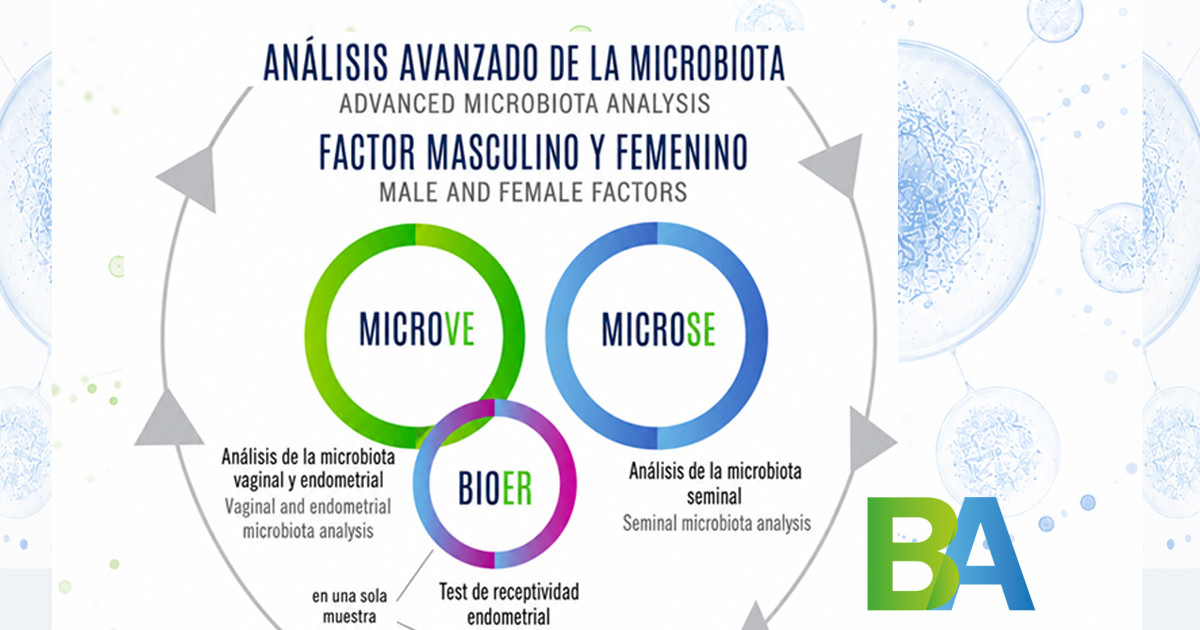
Vaginal, endometrial, and seminal microbiota can provide relevant information for a more comprehensive understanding of reproductive health. However, identifying the microorganisms present is only the starting point: it is also necessary to analyze their relative abundance, the relationship between different species, and the possible existence of an imbalance or dysbiosis.
With MicroVE and MicroSE, Bioarray offers a comprehensive approach to the study of the female and male reproductive microbiome through Next-Generation Sequencing (NGS), bioinformatic analysis, and specialized interpretation.
Because studying the reproductive microbiota is much more than detecting bacteria: the true value lies in transforming the obtained data into clinically useful information.
What is the Reproductive Microbiota?
The microbiota consists of communities of microorganisms that naturally inhabit different parts of the body. In the female and male reproductive tracts, these communities constitute dynamic ecosystems whose composition can vary among individuals and be influenced by hormonal, physiological, environmental, or lifestyle-related factors.
When the balance between different microbial populations is altered, we speak of dysbiosis.
Scientific research has found associations between certain reproductive microbiota profiles and aspects such as inflammation, seminal quality, sperm DNA fragmentation, embryo implantation, or some reproductive outcomes.
However, the presence of a specific bacterium should not be interpreted in isolation. To understand the microbiological profile of a sample, it is necessary to analyze the entire ecosystem and evaluate the results together with the patient’s history and all other available clinical information.
Why is simply identifying present bacteria not enough?
Two samples may contain similar microorganisms and yet present different microbiological profiles. The abundance of each species and the relationship between beneficial, dysbiotic, or potentially pathogenic bacteria determine the interpretation of the result.
Therefore, a comprehensive study of the reproductive microbiome should provide information on:
- The microorganisms present in the sample.
- Their relative abundance.
- The relationship between different species.
- The possible existence of an imbalance or dysbiosis.
- The relevance of the findings within the patient’s clinical context.
The real challenge is not just generating a large amount of data, but converting it into clear and useful information for a more complete and personalized assessment.
MicroVE: Vaginal and Endometrial Microbiota Analysis
MicroVE is the solution developed by Bioarray to study the composition of the female reproductive tract microbiota.
The analysis can be performed on a vaginal fluid sample, an endometrial biopsy, or through a combined study of both samples, depending on the needs of each case.
MicroVE allows analysis of:
- The relative abundance of the genus Lactobacillus.
- The composition of the different Lactobacillus species present.
- The possible existence of a dysbiosis profile.
- The presence of potentially pathogenic bacteria.
- Microorganisms that may be relevant in cases of recurrent vaginal infections, suspected chronic endometritis, or implantation failures.
Bioarray offers different modalities to adapt the study to the type of sample and clinical situation:
- MicroVE vaginal, to analyze the microbiota present in a vaginal fluid sample.
- MicroVE endometrial, to study the microbiota of an endometrial biopsy.
- MicroVE vaginal and endometrial, to obtain a joint assessment of both environments.
This way, the specialist can obtain complementary information about the microbiological balance of the female reproductive tract and integrate it with the results of other tests performed.
MicroSE: Advanced Seminal Microbiota Analysis
The evaluation of male fertility often relies on tests such as semen analysis or microbiological culture. These studies provide essential information but do not allow for a complete characterization of the bacterial ecosystem present in semen.
MicroSE is the test developed by Bioarray to analyze the microbiota of the male reproductive tract from a semen sample.
The study allows for:
- Identification of commensal and potentially pathogenic microorganisms.
- Evaluation of the relative abundance of detected bacteria.
- Identification of possible seminal dysbiosis profiles.
- Complementing semen analysis and microbiological culture with advanced microbiological information.
- Obtaining a more complete view of the bacterial balance of the male reproductive tract.
MicroSE can provide particularly relevant information in patients with idiopathic infertility, persistent alterations in seminal parameters, recurrent urogenital infections, or unfavorable reproductive history where the possible involvement of the male factor needs to be assessed.
It does not replace semen analysis or other conventional studies, but rather complements them by incorporating information about an aspect of the seminal environment that cannot be evaluated with the same level of detail using these techniques.
A Combined View of the Female and Male Microbiome
For a long time, female and male reproductive factors have been studied independently. However, fertility is a shared process, and growing scientific evidence suggests considering the couple as an interrelated biological ecosystem.
The complementary study of vaginal, endometrial, and seminal microbiota allows for expanded evaluation and identification of imbalances that may go unnoticed in conventional tests.
In this vein, the research presented by Bioarray at ESHRE 2026 simultaneously analyzed seminal microbiota, endometrial microbiota, and sperm genetic integrity. The results showed relevant associations between specific microbial profiles of both partners.
You can learn more about this research in our article on seminal microbiome and couple fertility.
This perspective does not imply that the microbiome alone determines reproductive outcomes. Its value lies in providing a new layer of information that can be integrated with the patient’s history, clinical examination, and other diagnostic tests.
NGS Technology and Specialized Interpretation
Bioarray’s reproductive microbiota studies are performed using Next-Generation Sequencing (NGS), analyzing hypervariable regions of the 16S rRNA gene.
Unlike microbiological culture, this technology also allows for the detection of non-culturable bacteria and provides a broader characterization of the microbial communities present in the sample.
The analysis is also supported by HVEN16S, Bioarray’s proprietary database, developed and curated specifically for the study of the human reproductive microbiome.
Its application allows for:
- Improved taxonomic resolution.
- Reduced ambiguity in identification.
- Better utilization of sequencing reads.
- More precise characterization of vaginal, endometrial, and seminal samples.
- Evaluation of the presence and relative abundance of microorganisms.
Sequencing is complemented by bioinformatic analysis and specialized interpretation. Because studying the microbiome is not just about detecting microorganisms, but about understanding what their presence represents within the entire sample.
MicroVE and MicroSE: Complementary Information for a More Complete Assessment
At Bioarray, we continue to research and develop evidence-based solutions to improve knowledge of the reproductive microbiome.
MicroVE and MicroSE allow for an integral approach to female and male microbial ecosystems, transforming data obtained through NGS into useful information for assisted reproduction professionals.
Both solutions are part of a more precise and personalized approach, where results are always interpreted within the clinical context of each patient or couple.
Would you like to know which study or modality might be most suitable for your patients?
Consulta nuestras soluciones para el análisis del microbioma reproductivo o contacta con el equipo de Bioarray para ampliar información.